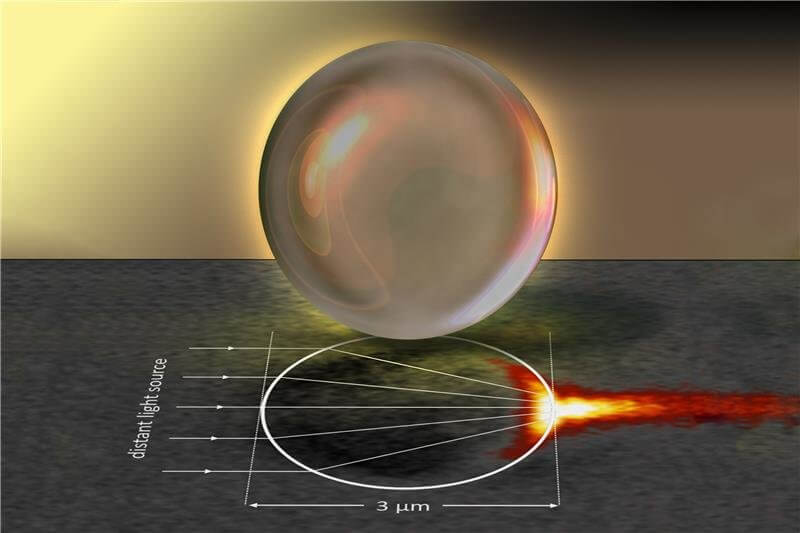
Scientists have tried to determine how bacteria perceive light from the moment they started using microscopes 300 years ago. An international team of researchers led by biologist Annegret Wild managed to solve this riddle: Having carefully studied cyanobacteria, the researchers found that these tiny organisms, a couple micrometers in length, move in the direction of the light source using the same principle that the lens works in the human eye.
Cyanobacteria inhabit the Earth for more than two and a half billion years, and you can find them wherever there is light: in the ice, in deserts, rivers, lakes, on the walls of buildings and in aquariums. They convert light into energy through the process of oxygen photosynthesis. In the oceans, covering about 70 percent of the earth’s area, oxygen-producing cyanobacteria are a central component of the biosphere. The Wild group found that cyanobacteria, which are able to move strictly in the direction of the light source, use their micro-optical properties to determine where the light comes from. Light enters the surface of these circular unicellular organisms, and then focuses on the opposite wall of the cell, as if it were a tiny lens. After that, cyanobacteria begin to move from this point of focused light, which causes them to move strictly in the direction of the light source.
All previous attempts to explain bacterial phototaxis (a process when bacteria move towards light) failed because these organisms, whose length is only several times longer than the light wave, were considered too small to feel the difference in light between the front and back of the cell. Since it has now become clear that the entire bacterium acts like a lens, organisms can concentrate light, creating a distinguishable light gradient inside the cell.
"The physical principle itself is almost the same as the light focused by the lens of our eyes," Wild explains. “Now we want to study the concentration of light in microscopic organisms that have a different form than a round - perhaps they can concentrate light like fiber.”
A better understanding of the micro-optical properties of cells can shed light on the degree of influence of the structure and shape of cells on the process of collecting light. This will make it possible to create artificial photobioreactors or new, more efficient types of solar cells in the future.
The article is based on materials .
Comments
Post a Comment