The first direct detection of gravitational waves is expected to be announced on February 11 by scientists at the LIGO (Advanced Laser Interferometer Gravitational-Wave Observatory) observatory. Using two giant LIGO detectors — one in Livingston, Louisiana, and the other in Hanford, Washington — the scientists measured the ripples of spacetime produced by the collision of two black holes and seemed to finally find what they were looking for.
Such a statement would confirm the gravitational waves predicted by Albert Einstein, which he made part of his general theory of relativity 100 years ago, but the consequences will not end there. Being a vibration of the fabric of space-time, gravitational waves are often compared with sound, they were even transformed into sound tracks. Gravitational-wave telescopes would allow scientists to "hear" phenomena in the same way that light telescopes "see."
When LIGO fought for funding by the US government in the early 1990s, its main rivals at the congressional hearings were astronomers. “At that time, it was believed that LIGO has nothing to do with astronomy,” said Clifford Will, a theoretician of GR at the University of Florida in Gainesville, one of the first supporters of LIGO. But since then much has changed.
Welcome to the field of gravitational-wave astronomy. Let's go over the questions and phenomena that she could reveal.
Do black holes really exist?
The signal that is expected from the LIGO announcement may have been produced by two merging black holes. Such events are the most energetic of all known; the force of gravitational waves emitted by them, may briefly eclipse all the stars of the observable universe in sum. Merging black holes are also quite easy to interpret using highly pure gravitational waves.
Black holes merge when two black holes spiral around each other, radiating energy in the form of gravity waves. These waves have a characteristic sound (chirp), which can be used to measure the mass of these two objects. After that, black holes usually merge.
“Imagine two soap bubbles that come so close that they form one bubble. A larger bubble is being deformed, ”says Tibald Damour, a gravitational theorist at the Institute of Advanced Scientific Research near Paris. The final black hole will be perfectly spherical in shape, but must first emit gravitational waves of a predictable type.
One of the most important scientific consequences of detecting a merger of black holes will be the confirmation of the existence of black holes - at least ideally round objects consisting of pure, empty, curved space-time, as predicted by the general theory of relativity. Another consequence - the merger takes place as predicted by scientists. Astronomers have plenty of indirect evidence of this phenomenon, but so far they have been observations of stars and superheated gas in the orbit of black holes, and not black holes themselves.
“The scientific community, including me, does not like black holes. We take them for granted, ”says Frans Pretorius, a specialist in UTO simulations at Princeton University in New Jersey. “But if you think about what an amazing prediction is, we need truly amazing evidence.”
Do gravitational waves move at the speed of light?
When scientists begin to compare the LIGO observations with those of other telescopes, the first thing they check is whether the signal came at the same time. Physicists believe that gravity is transmitted by particles-gravitons, the gravitational analog of photons. If, like photons, these particles do not have mass, then gravitational waves will move at the speed of light, corresponding to the prediction about the speed of gravitational waves in the classical theory of relativity. (Their speed can be influenced by the accelerating expansion of the Universe, but this should manifest itself at distances much higher than those covered by LIGO).
It is possible, however, that gravitons have a small mass, which means that gravitational waves will move with a speed less than light. So, for example, if LIGO and Virgo detect gravitational waves and find out that the waves arrived on Earth after gamma rays connected with a cosmic event, this could have crucial consequences for fundamental physics.
Is space-time cosmic strings?
An even more strange discovery can happen if bursts of gravitational waves are detected emerging from the "cosmic strings". These hypothetical space-time curvature defects, which may or may not be related to string theories, must be infinitely thin, but stretched over cosmic distances. Scientists predict that cosmic strings, if they exist, may accidentally bend over; if the string bends, it will cause a gravitational surge, which could be measured by detectors like LIGO or Virgo.
Can neutron stars be uneven?
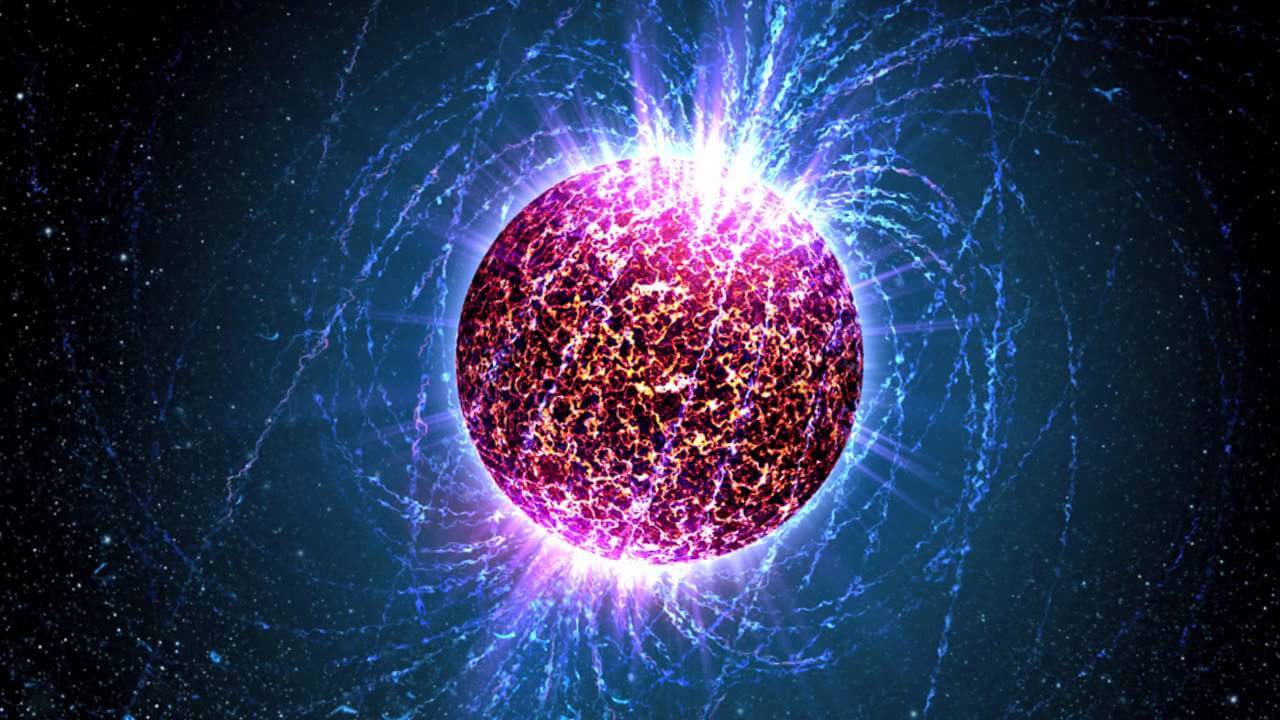
Neutron stars are remnants of large stars that collapse under their own weight and become so dense that electrons and protons begin to melt into neutrons. Scientists poorly understand the physics of neutron holes, but gravitational waves could tell a lot about them. For example, intense gravity on their surface leads to the fact that neutron stars become almost perfectly spherical. But some scientists have suggested that they can also be “mountains” - a few millimeters high - which make these dense objects with a diameter of 10 kilometers, no more, slightly asymmetric. Neutron stars usually spin very fast, so an asymmetric mass distribution will deform space-time and produce a constant gravitational-wave signal in the form of a sinusoid, slowing down the rotation of the star and radiating energy.
Pairs of neutron stars that rotate around each other also produce a constant signal. Like black holes, these stars spiral along and eventually merge with the characteristic sound. But its specificity is different from the specifics of the sound of black holes.
Why do stars explode?
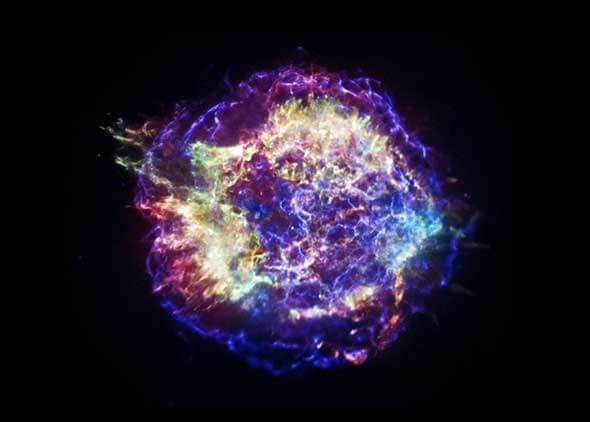
Black holes and neutron stars form when massive stars stop shining and collapse into themselves. Astrophysicists think that this process underlies all common types of Type II supernova explosions. Simulation of such supernovae has not yet shown why they are ignited, but listening to the gravitational-wave bursts emitted by a real supernova is believed to provide the answer. Depending on what the bursts are like, how loud they are, how often they occur, and how they correlate with supernovae that are monitored by electromagnetic telescopes, this data can help eliminate a bunch of existing models.
How fast is the universe expanding?
The expansion of the universe means that distant objects that are moving away from our galaxy look more red than they really are, because the light they emit expands as they move. Cosmologists estimate the rate of expansion of the universe by comparing the redshift of galaxies with how far they are from us. But this distance is usually estimated by the brightness of type Ia supernovae, and this technique leaves a lot of uncertainties.
If several gravitational wave detectors all over the world detect signals from the fusion of the same neutron stars, together they can accurately estimate the signal loudness, and at the same time the distance at which the merger occurred. They will also be able to assess the direction, and with it, identify the galaxy in which the event occurred. By comparing the redshift of this galaxy with the distance to the merging stars, an independent rate of cosmic expansion can be obtained, perhaps more accurate than modern methods allow.
The article is based on materials .
Comments
Post a Comment