
Depending on your point of view, the “Project Manhattan” - the cooperation of the USA, Great Britain and Canada, during which the first atomic bombs were developed - is one of the greatest and worst projects of our time. It can be said that the Manhattan project essentially ended World War II and thus saved millions of lives in the long run. We can also say that the Manhattan project led to decades of the Iron Curtain and the Cold War. Regardless of your point of view, everyone agrees that the physicists, engineers, and chemists behind the project were geniuses and professionals in their field. Or full of nerds.
After the atomic bombing of Hiroshima and Nagasaki, scientists from Los Alamos - where the first research center of the project was located - continued to conduct experiments on the subcritical plutonium mass with only a thin blade screwdriver (which the scientist kept!), Which prevented critical the room. Suffice it to say that sometimes the screwdriver slid off and the scientist who held it was instantly roasted with deadly neutrons.
Atomic age
As you know, two bombs were dropped on Japan. The Little Boy, “The Kid”, a fairly simple cannonball bomb filled with U-235, was dropped on Hiroshima on August 6, 1945. The Fat Man, the Fat Man, a more complicated bomb that exploded a plutonium sphere or nucleus dumped on Nagasaki three days later, on August 9th. On the same day, Emperor Hirohito began the process that ultimately led to Japan’s surrender and the end of World War II.
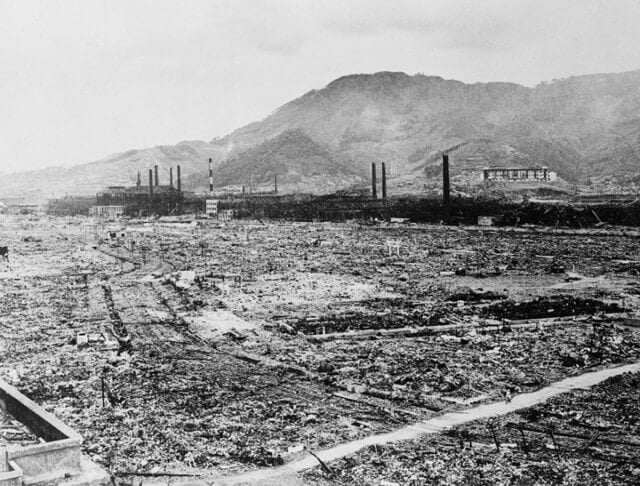
What you hardly know is that the Allied forces made three plutonium charges, worth $ 500 million each (most of the funds of the Manhattan project were spent on the production of fissionable uranium and plutonium fuel). The first charge was used in the Trinity experiment, which showed that the integrated implosion technique was in principle possible. The tests of Trinity, which were conducted on July 16, 1945, are considered the beginning of the atomic age. The second charge was blown up over Nagasaki and killed tens of thousands of people. The third charge ... The third charge was supposed to be dropped on Japan, but the capitulation of the country did not allow this to happen. Instead, the charge was taken to Los Alamos for further research, where he immediately killed a bunch of scientists and became known as the "charge-demon".
Charge demon
When an atom divides, it usually breaks down into two smaller atoms and at the same time emits several neutrons as waste. These junk neutrons can hit nearby atoms and cause them to divide. A nuclear fission type bomb explodes when, in fact, uranium or plutonium fuel becomes supercritical. This means that there are enough fissionable atoms (fissionable) so that the neutrons maintain a constant chain reaction of fission. This requires a certain mass and volume of material (the so-called critical mass). One of the key studies of the Manhattan project was to determine the precise controlled conditions in which you can take a conventional radioactive piece of uranium or plutonium and make it supercritical - thus creating an atomic bomb.
Although you might think that such supercriticality studies should be carried out by chemists and physicists who are a kilometer away from the bomb in the shelter and move fissile material with long metal fittings, the scientists at Los Alamos were great extremes. To determine the critical mass of plutonium nuclei that would be used for the Trinity experiment and the Fat Man bomb blast, a Los Alamos scientist, Louis Slotin, developed a procedure that Richard Feynman himself called nothing less than "dragging a dragon by the tail." In the course of this technique, Slotin, wearing blue jeans and cowboy boots, apparently lowered the beryllium hemisphere onto a plutonium charge. Beryllium is a neutron reflector, so if it is close enough to the nucleus, then the neutrons bounce back to plutonium, causing a supercritical state. Slotin almost completely covered the charge with a beryllium hemisphere, and the only thing that did not allow her to completely cover it was the sting of a flat screwdriver.
He pulled the dragon by the tail almost a dozen times before the screwdriver finally jumped off — on May 21, 1946 — as a result of which the charge of plutonium gained supercritical mass and emitted a massive neutron blast. Slotin talked about a flash of blue light and a wave of heat that passed through his skin before he could literally turn the beryllium reflector after just half a second, stopping a chain reaction. But it was too late: he received about 1000 sievert of radiation and died nine days later from acute radiation sickness.
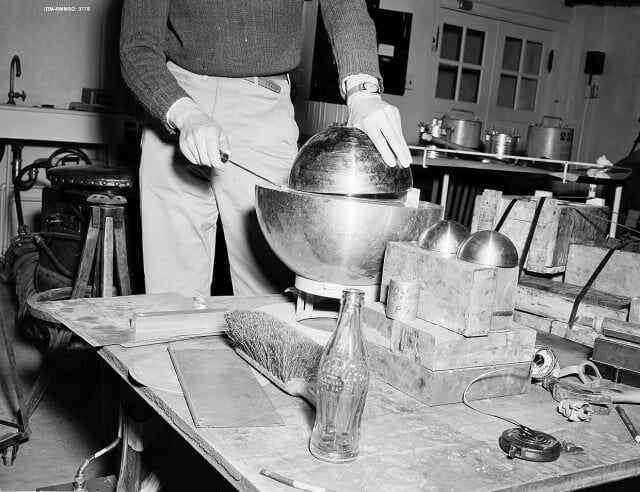
Alvin Graves, who was watching Slothin from behind his shoulder, survived, but received a number of vision and neurological problems - and died 19 years later from a heart attack, possibly due to the fact that radiation struck his heart. Since Slotin’s body consumed most of the neutron flare (what is the hero, huh?), None of the others died immediately, but at least two employees died in the next 30 years from radiation-related complications (cancer, anemia).
Not surprisingly, the criticality protocol of the experiment was changed immediately after the incident. The rest of the experimenters turned Slotin's screwdriver with a machine with a remote control for half a kilometer.
Why is "charge-demon"?
Believe it or not, a year before this, another incident happened - August 21, 1945 - a couple of days after the surrender of Japan. Again, exploring criticality, physicist Harry Daglyan placed tungsten carbide bricks around a charge-demon. Like beryllium, tungsten carbide reflects neutrons. The idea was to gradually arrange the bricks around the core, while the scintillation counter determines the criticality of the charge.
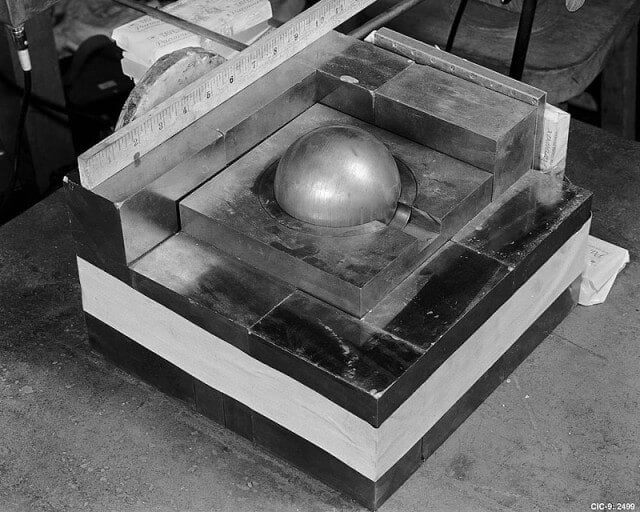
Unfortunately, Daglyan missed and dropped the brick on the charge, as a result of which he became critical. The scientist removed the brick and stopped the reaction, but 200 sievert radiation was already in it. Daglyan died 25 days later from acute radiation sickness, and the guard, who was standing outside the room, died 33 years later from cancer. The only good thing about this story is that Daglyan himself worked in his laboratory.
Boom
Shortly after Slotin’s death, and perhaps due to the growing discomfort among scientists at Los Alamos, the charge-demon was blown up as part of experiments with nuclear weapons during Operation Crossroads. The charge, which was assembled into a bomb called "Gilda", exploded, as expected, with the release of about 23 kilotons of TNT equivalent - for comparison, "Fat Man" over Nagasaki rushed to 21 kilotons. “Gilda” was blown up over the decommissioned battleship USS Nevada to see if nuclear bombs could effectively sink ships, but the missile missed the target by a kilometer.
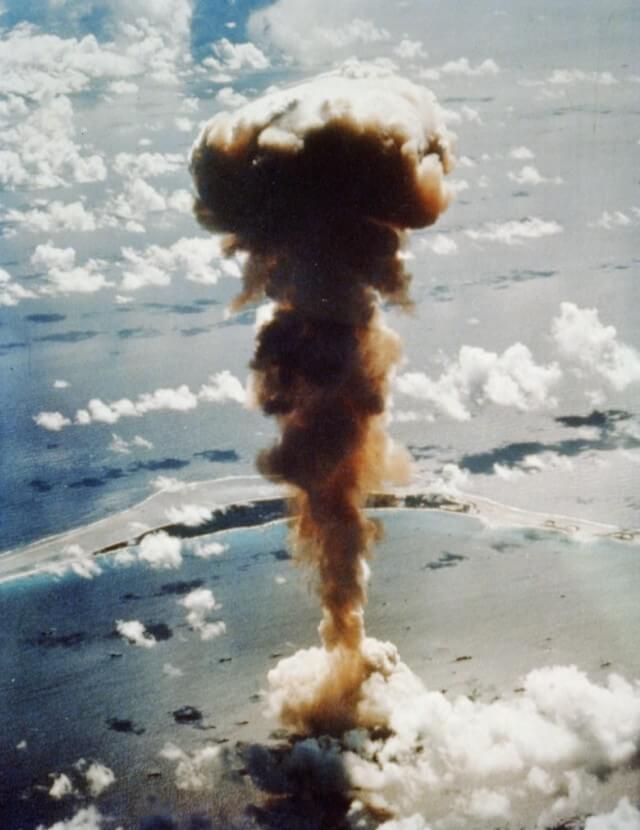
As you can see in the photo, there were no demonic signs at the site of the explosion of “Gilda”, just an ordinary mushroom. Such is the story of the “charge demon”. I hope it was interesting.
By materials arstechnica. com
The article is based on materials .
Comments
Post a Comment