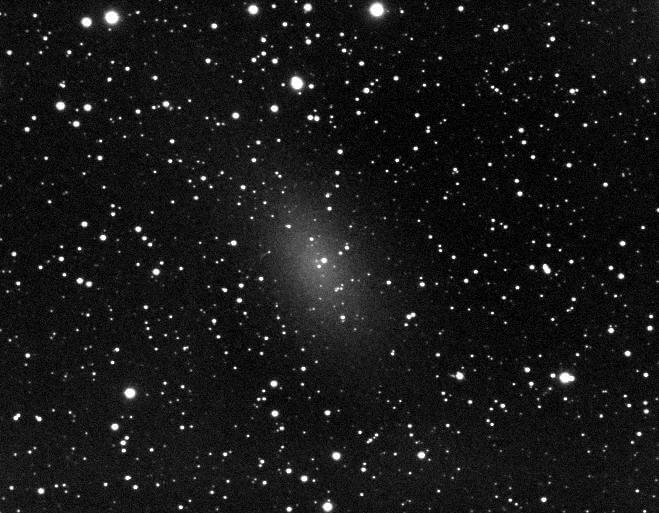
A group of astronomers from the Massachusetts Institute of Technology (MIT) in Cambridge, working under the guidance of expert Anna Fröbel, announced that she had discovered an incredibly ancient galaxy adjacent to the Milky Way. The discovered object, according to scientists, may be one of the very first galaxies formed in the Universe, and discover new information about the time when the cosmos was only formed.
This statement is based on a deep analysis of heavy chemical elements inside the stars inside the segue 1 spheroidal dwarf galaxy. Scientists can present the history of a star by analyzing the metallicity. The essence of the process is to determine how heavy elements are formed inside a star during a thermonuclear reaction.
When the first stars appeared, reactions took place inside them, as a result of which hydrogen isotopes, such as deuterium and tritium, turned into helium. When these objects turned into giant supernovae, helium spread into space and in fact became the cradle for the formation of new stars. Inside the second generation of stars, reactions were already taking place, in which hydrogen and helium turned into heavier elements, such as silicon, carbon, and oxygen. Since then, the process is constantly repeated and more and more heavy elements are formed in the core of stars. According to the portal Nature News, by analyzing the metallicity of each star, researchers can form a definite opinion on how this object was formed. The study showed that the metallicity of stars in the Segue 1 galaxy is very low, indicating that there are very few heavy elements left in them, and the stars themselves are very old.
Overall, the MIT study determined that this dwarf galaxy, located about 75 light years from the Milky Way in the constellation Leo, completed its development no earlier than 13 billion years ago. Given that the age of the Universe itself is 13.75 billion years, this means that the object studied, also known as the globular cluster, formed less than 1 billion years after the Big Bang.
If this information is confirmed after re-verification, then Segue 1 may well become a kind of measure for determining the processes that took place in the early stages of the formation of space. Future analyzes of the dwarf galaxy may also indicate how some of the largest galaxies in the universe were formed. The study of these processes is incredibly difficult, so Segue 1 for scientists in the literal sense can be a hint to the solution of this problem.
As part of the study, scientists using the Magellan telescopes located in the Las Campanas Observatory (Chile), as well as the Keck Observatory telescopes (Hawaii), analyzed the metallicity of the six brightest stars inside the Segue 1. the library of scientific materials arXiv.org, and also accepted for publication in the new issue of the scientific journal Astrophysical Journal.
The team of scientists found only minor traces of heavy elements (for example, iron) inside these stars prompted the research team to the idea that a dwarf galaxy is one of the least chemically developed galaxies in space.
“Segue 1 is so poor in heavy elements that it makes us think that at least several of the stars located inside it are actually among the first stars that appeared in the Universe” - Evan Kirby, expert from the University of California in Irvine and co-author of this study.
The article is based on materials .
Comments
Post a Comment